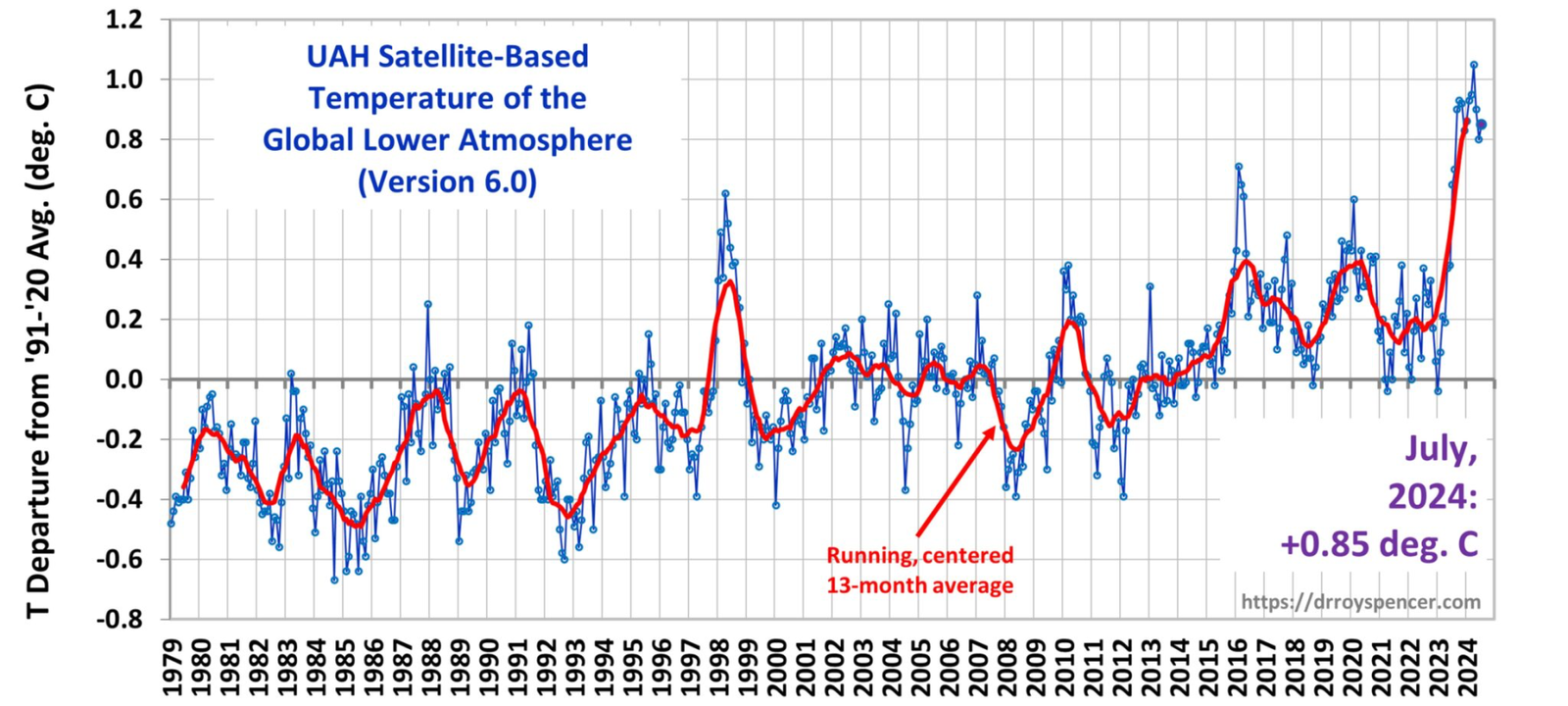
The temperatures in the chart below are anomalies, that is how much the temperature in any month differs from the average for that month for the period 1991 to 2026. Although, obviously, the general trend is up, there are huge swings up and down, in some cases as much as 0.8º C (1.4º F). Before discussing this, I would like to show the graph for the much larger annual variation of the earth’s temperature of 3.7ºC:

This swing in temperatures is because the northern hemisphere contains 35% more land than the southern, and land does not retain heat as well as oceans.
On my page about the oceans I discuss how sparse our sampling is below the ocean surface and how we know almost nothing about the deep ocean under 2,000 meters. We do know that ocean surface temperatures shift dramatically from year to year, even month to month, but we cannot accurately predict the timing of the shifts, or in many cases the reasons. For example, between March of 2020 and March of 2021 the satellite measured temperatures of the air above the oceans worldwide cooled by 0.41ºC (0.31ºC north of 20ºN, 0.61ºC in the tropics, and 0.67ºC south of 20ºS). Also, the temperatures of the oceans during March 2021 worldwide were 0.29 C below the January and February temperatures of that year. Furthermore, the satellite temperatures of the northern hemisphere oceans versus the tropics versus the southern hemisphere oceans vary dramatically from month to month!1 Would you like me to explain? I can only guess: There must be massive currents coursing through the oceans that nobody has heard of.
We do know about certain sea temperature oscillations. The most famous is the El Niño Southern Oscillation (ENSO),2 that describes an alternation between calm, El Niño and La Niña, off the coast of South America. There is no name for the situation when the upwelling of cold southern currents off the coast is moderate. La Niña takes place when the westerly trade winds that normally are weak blow sun-heated surface water away from the South American coast. Cold water at the South American coast is denser and therefore heavier than warm surface water, but when the surface water is removed, colder water will upwell to replace it or arrive by the cold northward current along the South American coast from the Antarctic, where it is replaced by deeper water. In an El Niño, the winds cease entirely or reverse, and the hot water that has built up in the western Pacific Ocean flows to the South American coast. Even though ENSO has been unpredictable, this has not stopped oceanographers from creating models; there are many of them.
The strongest El Niño and La Niña events have been correlated with increases and decreases of worldwide temperatures. Very strong El Niños are followed the same and next year by 0.1º to 0.2º C increases in worldwide temperatures and very strong La Niñas by 0.3º C decreases. The average temperature of the tropical seas where El Niño and La Niña occur are 22-28º C3; while the average temperature of the earth’s land is 8.6º C. The data I have looked at (my calculations) show that land temperatures increase more than ocean temperatures by very roughly 2.5 times during and after strong El Niños, and that they decrease more than ocean temperatures by about 1.8 times during strong La Niñas.
The “reservoir” for El Niño water is the western Pacific. In normal and La Niña years, the trade wind and the equatorial current push warm water to the western pacific near Borneo, where it literally “piles up” and also becomes deeper. The mixing layer is much thicker in the western Pacific, as was illustrated in the graphic above; it can vary from 100 to 300 meters in depth. Recent studies find it has gotten deeper and more stratified. The western Pacific mixing layer can warm the planet if it spreads out. I have only seen this discussed very recently, but it is in fact rather obvious. An animated graphic of sea surface temperatures from month to month over many years shows than in warmer years the high temperature layer on the surface is expanded — north and south, and sometimes west all the way to the Indian sub-continent, sometimes at the same time as it has spread east in El Niños.
Temperature readings are taken from the very top skin of the ocean, and it is this layer that transfers heat to the winds. (The tropical ocean is warmer, on average, than the air above it.) So, it is evident that hotter air temperatures worldwide can arise from the ocean — whether caused by the movement of water by winds or by the pressure of deep ocean currents.
There are many other powerful upwelling oscillations, as well as large fluctuations in the known ocean currents, all of which have a strong effect on regional and world climate.4 Many of these occur in areas that have poor historical records and are only being considered today.
Variations in upwelling, in ocean currents and surface spreading, and in the winds that affect them surely are responsible for most year-to-year fluctuations in the earth’s temperature, and they may also alter the climate for decades. Some models predict that the Gulf Stream will stop with continued climate change, which would devastate agriculture in northern Europe.
- See satellite temperature data by month and region here: http://vortex.nsstc.uah.edu/data/msu/v6.1/tlt/uahncdc_lt_6.1.txt ↩︎
- A description of the upwelling processes is here: https://en.wikipedia.org/wiki/Upwelling ↩︎
- https://www.cen.uni-hamburg.de/en/icdc/data/ocean/hadisst1.html ↩︎
- https://www.whoi.edu/know-your-ocean/ocean-topics/how-the-ocean-works/ocean-circulation/el-nio-other-oscillations/ ↩︎