The climate progress in Europe has been too little and too late, but that is better than none. A look on this page at Denmark and Germany.
A great majority of Denmark’s energy is not environmentally friendly.
Denmark has made remarkable progress using wind, but it still is 85% dependent upon carbon emitting fuels.

Denmark uses wood pellets and fossil fuels for electricity, heating and transportation. By 2024 wind, solar and biofuels may have exceed 50% of all energy supply, a number which Denmark widely publicizes. However, Denmark counts its wood pellets as green, but, as I show on a\my dedicate page, they are much worse than coal. So, counting them correctly, 78 percent of Denmarks domestic energy use is from high emission sources! To this we must add the electricity from abroad that is generated by fossil fuels.
Denmark miscounts electricity from the wind.
Denmark’s on shore winds are on average only 11-12 mph (19 km/hour) at a height of 10 meters, but off shore at 90 meters height they are about an estimated 22 mph (32 km/hour). The depth of the seabed off Denmark is only 10 – 20 meters, compared to 37-50 meters off the Atlantic coast of the United States, where wind projects are being costructed. The countryside is flat and a great majority is fields. The North Sea and Baltic Sea adjoin. Denmark’s population is about 5.9 million. Denmark annually uses one-half as much electricity per capita as the USA — about 33 billion kWh (2020). This situation is highly favorable for using wind. (However the average efficiency of the wind turbines installed was only 24% in 2022, so huge numbers of turbines must have been installed.)

Source of chart: https://www.statista.com/statistics/1235360/denmark-distribution-of-electricity-production-by-source/
But, despite the above graph, arguably Denmark gets only around 18% of its electricity from wind!
Per year Denmark produces 20.85 billion kWh of electricity, of which it exports 12.7 billion or about 61% (2024). Since it would not be economic to burn bio- or fossil fuels in order to export the electricity, the most must of the export must come from the wind. By subtraction, this leaves 12% of the wind generated for domestic use, which makes sense only if the peak turbine production does not correspond at all with electrical demand. Denmark also imports 60% of its electricity! This is not surprising, because often there is no wind or very little wind. Where does this imported electricity come from? Other European countries almost never have an excess of nuclear, solar energy, or wind capacity. So the imported electricity comes from fossil fuels. (France sometimes exports energy from nuclear plants, but Denmark does not abut France.)
No other nation is even close to having capacity to supply its domestic electrical needs from wind, — much less export it —or has the geographic position, the low per capita electrical demand, and low population to do so.
Denmark uses 15% more electricity than it generates. Calculating on the total base of usage, 30% of its electricity is from domestic CO2 emitting fuels and 52% if from imported fossil fuel electricity. Only 18 % of all electricity it uses is from wind/solar generation.
Should we give mental credit to Denmark for the 60%% of its wind-produced electricity that it exports?
Germany: More than 80 – 85 % of energy is still from high emission sources.
The green political movement has been especially powerful in Germany. So how much reduction has there been in fossil fuel use?

Over the 50 plus years, gas and nuclear replaced coal, and nuclear is now being replaced by wind and solar energy. Because the German economy is large (population 84 million), this is perhaps the largest saving of CO2 in Europe.
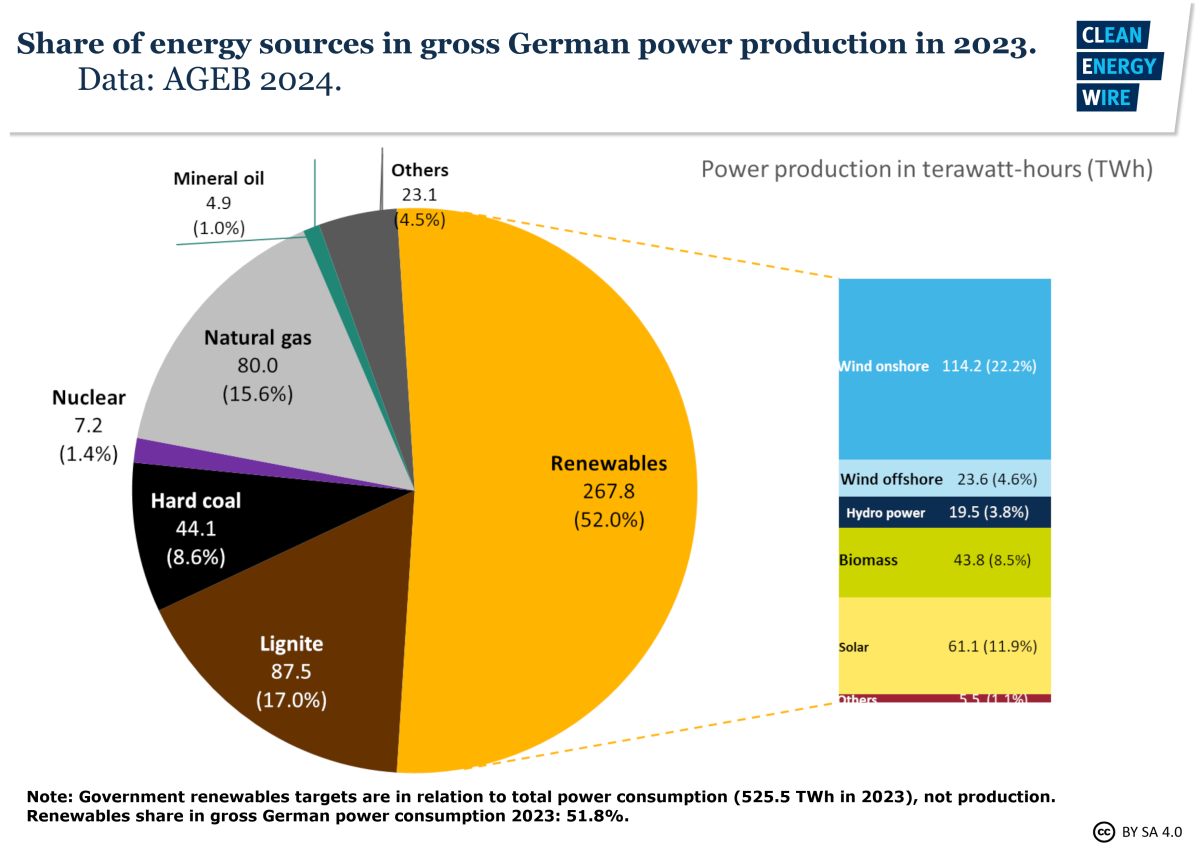
The above charts show that after deducting biomass, about 44% of all electricity produced in Germany comes from low CO2 sources.