The cause of today’s climate change, in order of priority, are:
Human Caused Greenhouse Gases
Less Pollution causing fewer clouds
Ocean Stratification
Feedbacks from warmer temperatures:
…..Fewer clouds (also)
…..Greater natural greenhouse gas emissions
Urban Heat Island effect
Human Caused Greenhouse Gases: the main cause of climate change:
See a detailed discussion of why human causes are nearly certain on my page Are humans causing climate change. See a detailed discussion of how greenhouse gases work on this page.
Carbon Dioxide (CO2) is by far the most prevalent human-affected greenhouse gas, so much so that even though it has the weakest effect per unit, it has the largest effect on the atmosphere. CO2 is emitted by combustion, whether of coal, oil, natural gas, wood or plant or animal wastes.
Methane (CH4) is by far the second most influential greenhouse gas. The number of molecules in the atmosphere is 1/200th that of CO, but methane has a greenhouse effect that is approximately 140 times more powerful than CO2 by weight when emitted, 80 after twenty years and 30 after 100 years. My studies suggest that its greenhouse effect is larger than the official number. The largest human-caused sources of methane are fossil fuels and bovines (cattle, water buffalo, etcetera), all of which are increasing. Natural emissions of methane are increasing with hotter temperatures.
Nitrous Oxide (N2O) is a very powerful greenhouse gas with a comparison value of 300 by weight when emitted and perhaps 270 after 100 years. The number of molecules in the atmosphere is said to be 1/6 that of methane. But this is also probably an under count. About four-fifths of atmospheric N2O originates from the use of nitrogen fertilizer in agriculture and one-twentieth is from animal dung. Natural emissions of nitrous oxide are the rest. Natural emissions are rising with increasing temperatures.
Refrigerant gases used today (usually HFCs) have very high greenhouse values, often over 1000 , and they often live for hundreds or thousands of years. Some usages, such as supermarkets, can leak up to 25% a year, and in homes refrigerant may leak out due to punctures or age or failure to recycle. Warming caused by refrigerant gasses is presently about 2.5% of that from CO2.1 Legislation has mainly eliminated the refrigerant gases that were destroying the ozone layer, but not those with a high greenhouse effect. In most situations, it as been impractical or impossible to replace HFC’s with low-emission gases. The amount of refrigeration gases emitted is increasing at the fastest rate of any greenhouse gas, multiplying around 4 times since 19902 .
Despite the glib talk of limiting them, the amount emitted of every greenhouse gas has been growing every year.
Less Pollution: the second-most cause of recent climate change:
The historical emission of two pollutants has held down temperature increases. The great reduction of these since 1970 has been responsible for perhaps up to one-half of recent warming worldwide. Their effect has been greatest in the region where they have been emitted.3
The pollutants affecting the climate have been, mainly, sulfur dioxide (SO2), then carbon particles. The principal historical emitter of both has been coal. Fuel oil also has contained as much as one-half percent sulphur. With the reduced use of coal and the adoption of very low sulphur fuel oil, SO2 and carbon particles have greatly decreased in recent years. In the UK, for example, SO2 emissions have decreased 98% since 1970.4 This may well be mainly responsible for the much warmer climate recently in the U.K.

Sulfur dioxide and to a lesser extent carbon particles had a double effect in warming temperatures: first, SO2 combined with water vapor to form tiny particles of sulfuric acid that reflected the sun; and second these particles seeded clouds which also reflected the sun. In addition, the lack of these seeding particles has decreased rain.
Throughout the industrial revolution pollution held down climate warming. They even, in 1860 to 1880, 1900 to 1920 and 1940 to 1960, caused the climate to cool slightly. In 1980, before recent SO2 reductions, the Intergovernmental Panel on Climate Change (IPCC) estimated that aerosols reduced global temperatures by about 0.4º C. So since 1980, assuming an 80% worldwide reduction, these reductions must have increased world temperatures by 0.32º C, which is equal to more than one-half the entire rise in temperature from 1980 to 2023. The reductions of polution are continuing.
Ocean stratification has increased Climate Warming:
In 2024 all the world’s oceans have reached the hottest temperatures ever.
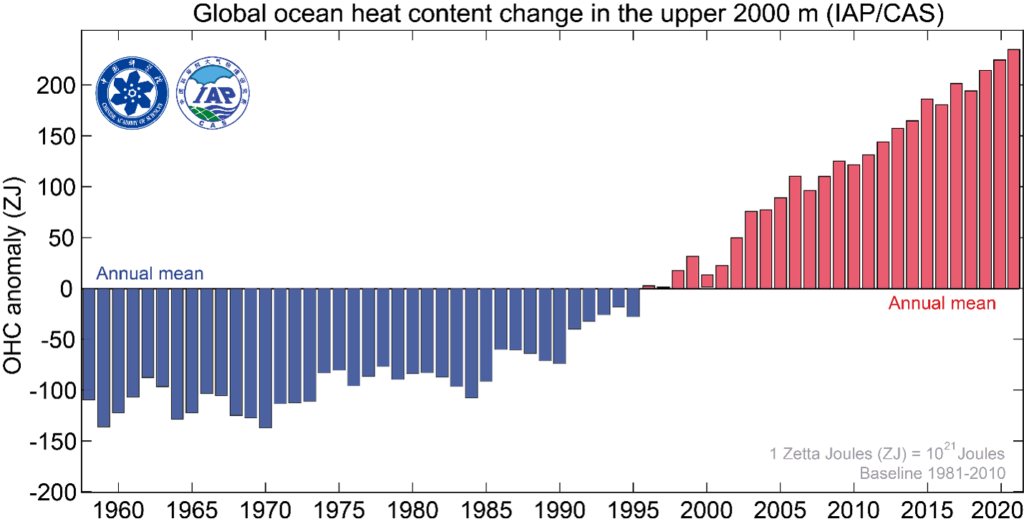
The average temperature of the entire ocean is 5C — far less than the upper layer — so when the top water mixes with the water further down it limits the rise in temperature. (See the graphic below.)
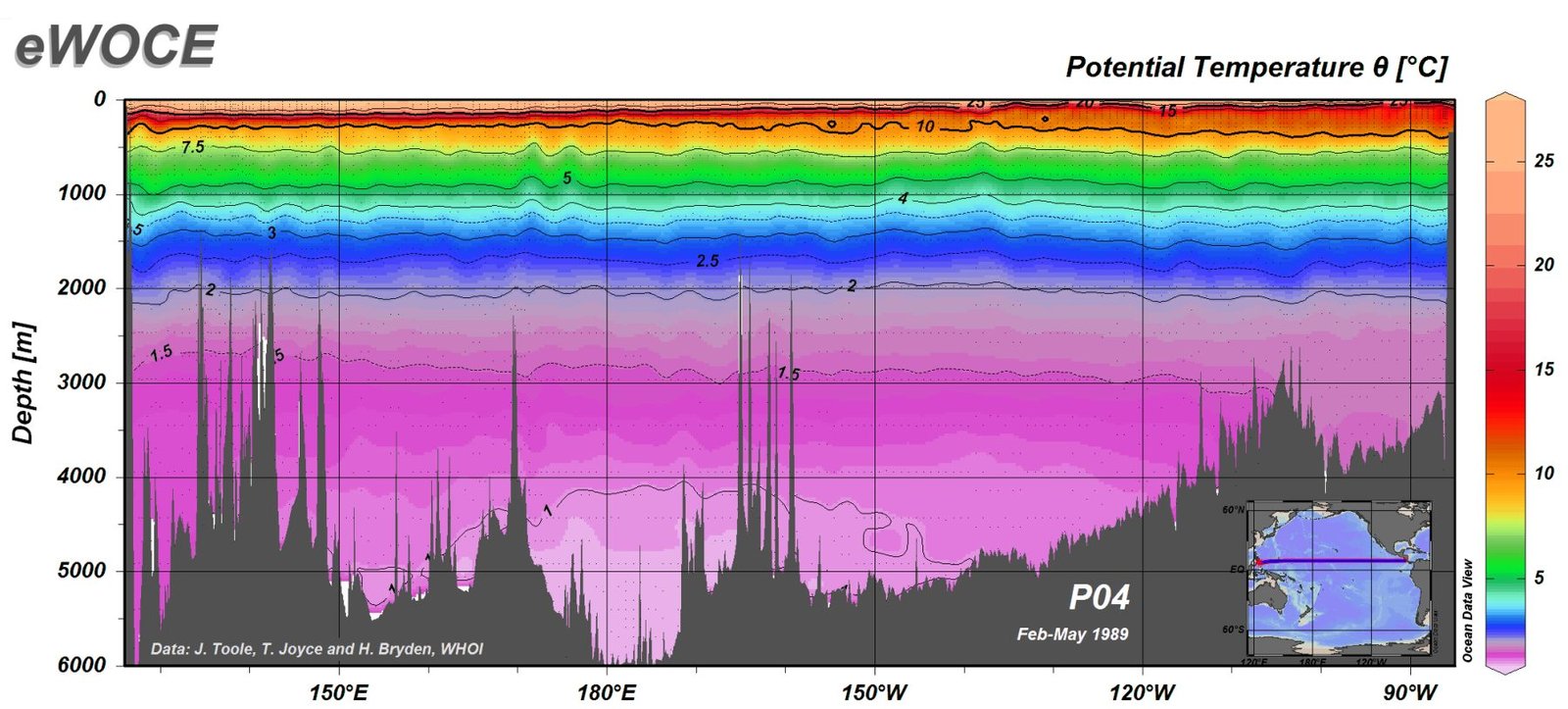
A study published in 2021 in the journal Nature5 found that world’s oceans have become more stratified each decade as far back as the data goes (to 1970); that is the upper layer of the ocean is not mixing as much with the layers below, and the study found also that the upper layer was getting thicker; that is, more warm water had accumulated there. This is happening, it is believed, because hotter water is less dense and also because the surface layer has become less salty due to glacier and iceberg melt. The illustration below shows the temperature distribution of the oceans.
Obviously, if the hot upper layer waters are not cooled by lower ocean layers, they will remain hot and get hotter — and since oceans are hotter, land temperatures will also become hotter.
Cloud changes and greenhouse gas increases from warmer temperatures are accelerating warming.
Recent studies of clouds have found that, apart from pollution reduction, warmer temperatures are reducing cloud numbers and reflectivity.6 7 If many clouds disappear, at least 4% more solar radiation would reach the earth. According to Climate.gov, a .07% change in solar irradiation (the maximum amount that the sun has varied over the historical record) would result in a 0.1 degree change. Thus a 0.7% change wold result in a temperature change of 1 C, and a 4% change would result in a change 5.7º C (10.3ºF warming)! Many climate models are being updated to predict this!
Warming temperatures are also increasing the rate of nitrous oxide and methane emissions from wetlands and landfills; and they are increasing the rate of melting of the permafrost. A recent study of 2000 melted permafrost sites8 found that while they were on balance emitting only a little CO2, they were emitting larger amounts of methane and nitrous oxide than forecast by climate models. This has been labeled the “methane bomb”, but might be called the “methane and nitrous oxide bomb”.
Urban Heat Islands affect the temperature people experience:
Most people live in sizable urban areas, although they are only 1% of the earth’s surface. The temperatures that most people experience, as well as the temperatures reported by most weather stations, reflect the urban heat island effect. Cities sizes have increased by 2,3,4 or more times in the last 100 years so today’s heat island effect is much stronger. Heat island effects are caused by structures trapping heat, and for that reason are bigger at night.
It is common knowledge that temperatures are warmer in a city than in the country. The organization Climate Central, in 2023, measured the heat island effect in United States cities that have over 550,000 inhabitants— where 80% of the US population lives. They found that all cities (when city areas were weighted by population) had more than a 7.2º F (4.0º C) heat island effect. New York City had a 9.5º F (5.3C) heat island effect. Other studies have found that London is 4.5ºC hotter (8º F) than rural surroundings, and that Central Paris 3ºC (5.4º F) hotter than its suburbs, which are hotter than rural areas.
The land temperatures used by governments are at least 0.1ºC hotter than satellite temperatures, because weather stations today are more frequently in urban areas and near heat sources such as airports Satellite world temperatures are are therefore a better indications of total global warming.
Are we slowing climate warming?
- https://www.fluorocarbons.org/environment/climate-change/atmospheric-concentrations ↩︎
- https://www.ipcc.ch/report/ar6/wg3/downloads/report/IPCC_AR6_WGIII_SPM.pdf ↩︎
- See maps on a Google search “map of so2 concentrations in atmosphere” ↩︎
- https://www.gov.uk/government/statistics/emissions-of-air-pollutants/emissions-of-air-pollutants-in-the-uk-sulphur-dioxide-so2 ↩︎
- https://www.nature.com/articles/s41586-021-03303-x ↩︎
- https://e360.yale.edu/features/why-clouds-are-the-key-to-new-troubling-projections-on-warming ↩︎
- https://www.imperial.ac.uk/news/194738/thanks-clouds-climate-simulations-predict-more/ ↩︎
- https://essopenarchive.org/users/659537/articles/663466-the-net-ghg-balance-and-budget-of-the-permafrost-region-2000-2020-from-ecosystem-flux-upscaling ↩︎